
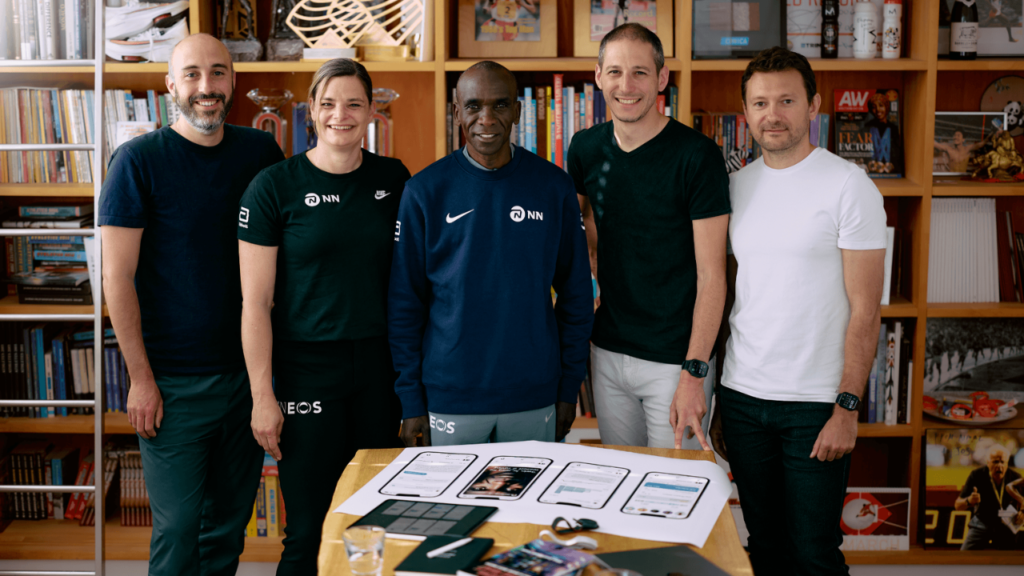
When two time Olympic champion Eliud Kipchoge launched Kotcha, an AI powered running coach built using insights from his NN Running Team, I decided to test it for 7 days straight, and what stood out immediately was how human the experience felt because this is not a static training app but something that adapts, responds, and guides you like a real coach, and if you are planning to try it, you can use code ARUJ to get one month free which makes it even more worth testing.
What Is Kotcha? (Kipchoge’s AI Running Coach)
Kotcha launched on October 23, 2025 and quickly went viral in the running community. It’s an AI-powered training app co-developed with Kipchoge and his NN Running Team. The goal is to “share not just the training structure, but the full support system” behind Kipchoge’s own training. In other words, Kotcha brings elite coaching to everyday runners. Its tagline, “train like the best, run like yourself,” captures this mission.
Instead of generic 12–16 week plans, Kotcha creates fresh weekly plans that evolve with you. Every Sunday it reviews your last week’s workouts and feedback, then generates the next week’s schedule – just like a real coach would. The app features four AI coach personas (Head Coach K, Trainer Alix, Nutritionist Dan, and Data Analyst Ben) that encapsulate Kipchoge’s team expertise. In tests by the founders, over 300 runners validated that Kotcha “recreates the feel of a real coaching team” with these adaptive features. As Kipchoge himself says, “running is a team sport” and Kotcha gives you that team in your pocket.
Setting Up My Training Plan
I downloaded Kotcha (available on iPhone and Android) and began with a brief questionnaire. In minutes I entered my age, recent 5K pace, current weekly mileage, how many days I want to run, and a target race distance/date (I chose a 10K goal). With this info, the app immediately generated Week 1 of a personalized 10K training plan. The plan included easy runs, a long run, and specific workouts (intervals, tempo, etc.) timed to my level.
Importantly, I could pick 3 or 4 running days per week. Kotcha then ensured one easy run and one long run each week by default, if I opted for 4 days, it would add two higher-intensity sessions for me. This flexibility lets you balance ambition with recovery. (Kotcha supports plans from 5K up to full marathon, so you can adjust to your distance.)
Kotcha’s approach is fully adaptive. Instead of a static plan, your schedule responds to your progress. Every Sunday, the AI re-evaluates your data and feedback, then designs the “perfect next week.” If you miss a run or rate a workout as very hard, Kotcha will adjust intensities or repeat similar sessions later, much as a human coach would. In fact, when I deliberately skipped a workout as a test, the app noticed and kept my next week’s plan in tune with my current fitness, rather than blindly ramping up mileage.
Daily Workouts & Tracking
Each workout from Kotcha is delivered as a discrete session with clear instructions. For example, a typical run in my plan included a title (“Progressive Run”), total time (e.g. 45 min), distance (if applicable), detailed pacing (e.g. run easy for 20 min, then build effort), and even a motivational message from Coach K. The workouts mirrored the workouts Kipchoge’s runners do: steady endurance runs, progressive tempo runs, interval sessions, plus recovery jogs and a Sunday long run.
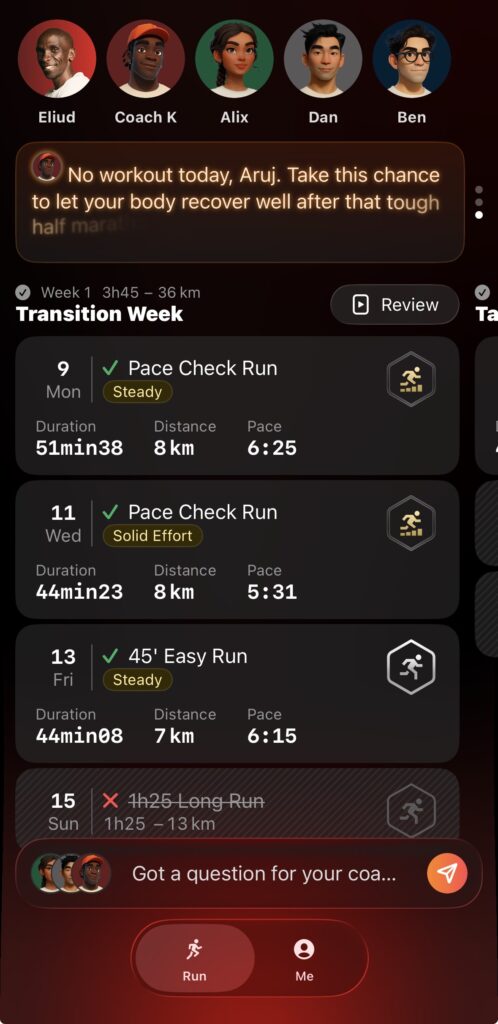
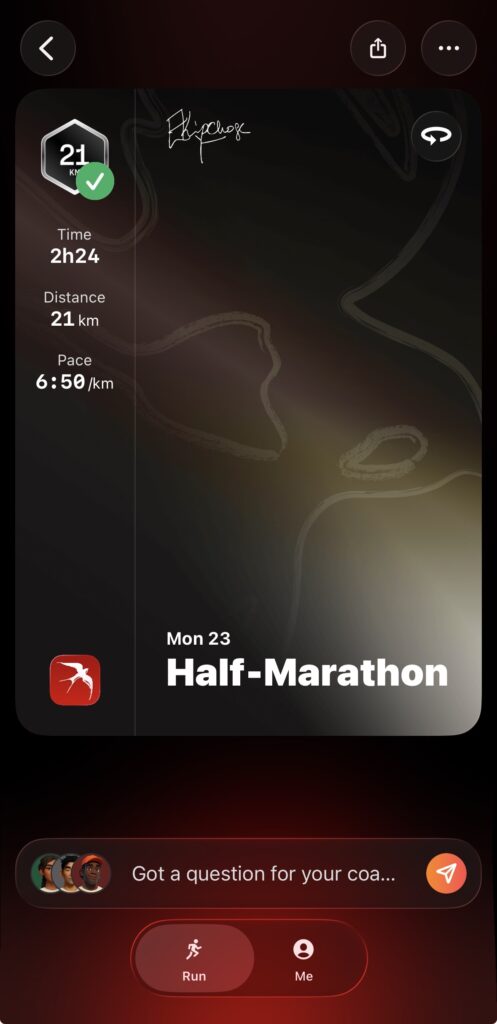
A big convenience: Kotcha syncs with GPS watches. I linked my Garmin, and every workout I completed automatically uploaded. The app supports Garmin, Apple Watch, Coros and Huawei. I could send a workout directly to my watch beforehand so that even complex interval sets were pre-loaded – no fiddling with timers mid-run. After each run, the data synced back to Kotcha in under a minute. Instantly, “Ben,” the AI data analyst, popped up to highlight my pacing and heart rate trends.
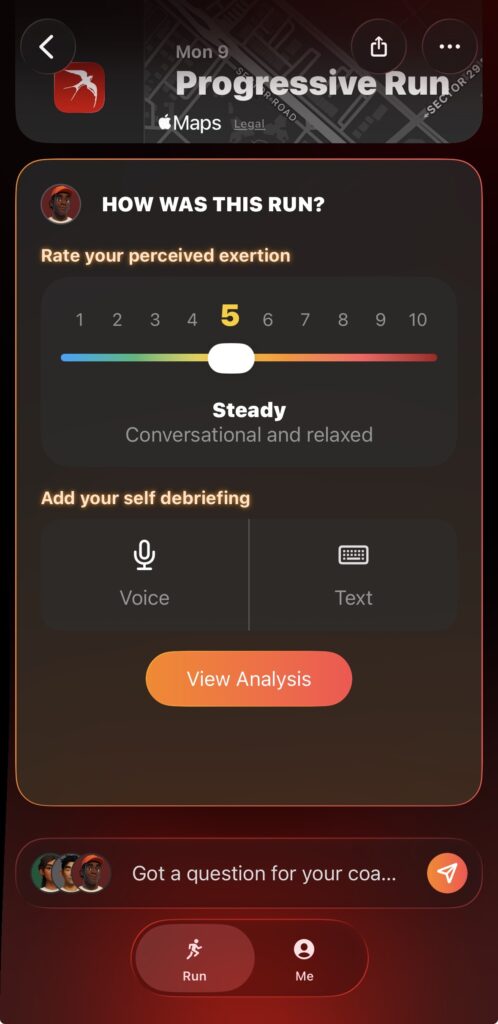
After logging a session, I was prompted to rate it on a 1–10 perceived exertion scale, and at week’s end to say whether I felt “tired,” “okay,” or “great” overall. The app uses that feedback to fine-tune future workouts. For instance, if workouts feel too hard, it might ease off, if they seem easy, it might nudge up intensity. This closed-loop feedback – coach, runner, adjust – is what makes Kotcha more personalized than just following a preset plan.
Chat with Your AI Coaches
One of Kotcha’s standout features is the built-in chat assistant. On the app’s main screen, you’ll see a chat bar where you can ask any running question. Each inquiry is answered by the relevant AI persona from Kipchoge’s team. For example:
- Coach K (Head Coach): overall training strategy (e.g. how to improve pace).
- Alix (Trainer): injury, strength or form questions (she’s like a virtual physio).
- Dan (Nutritionist): fueling and diet advice.
- Ben (Data Analyst): metrics, heart rate zones, or plan tweaks.
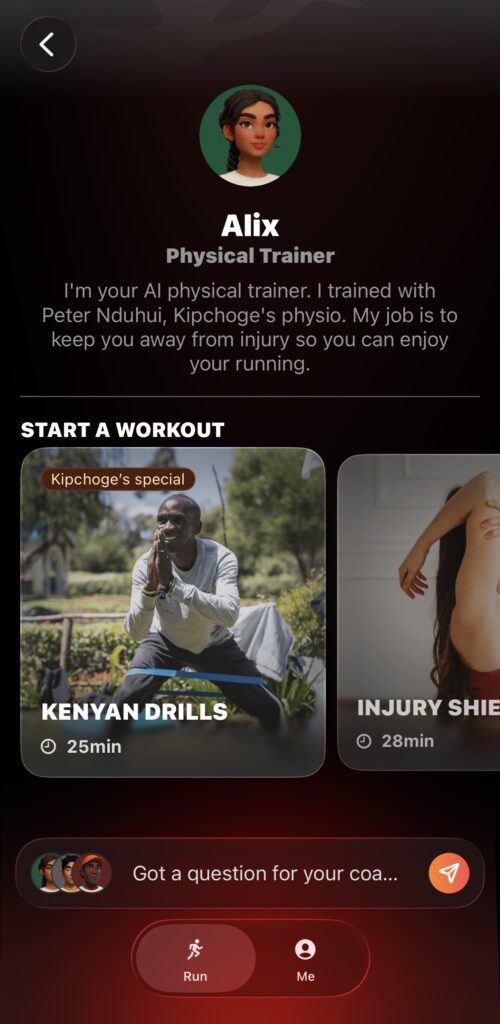
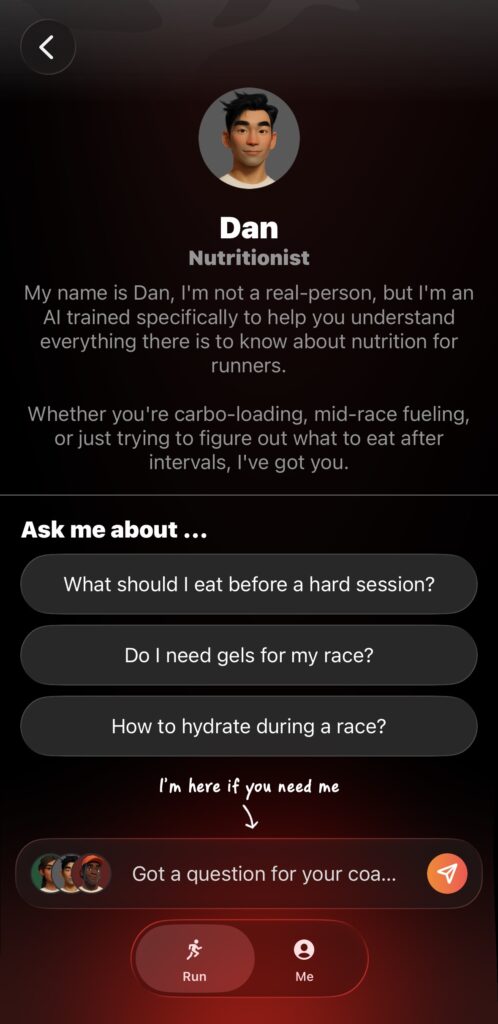
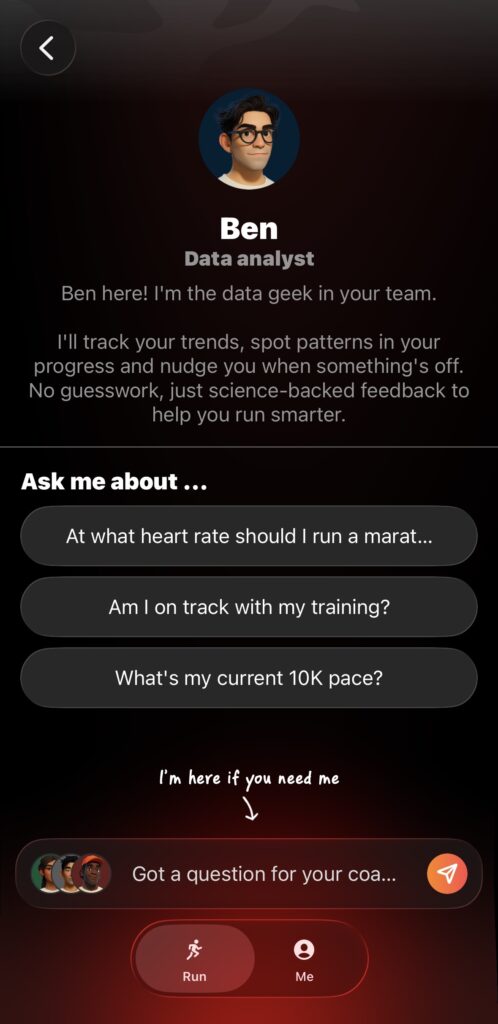
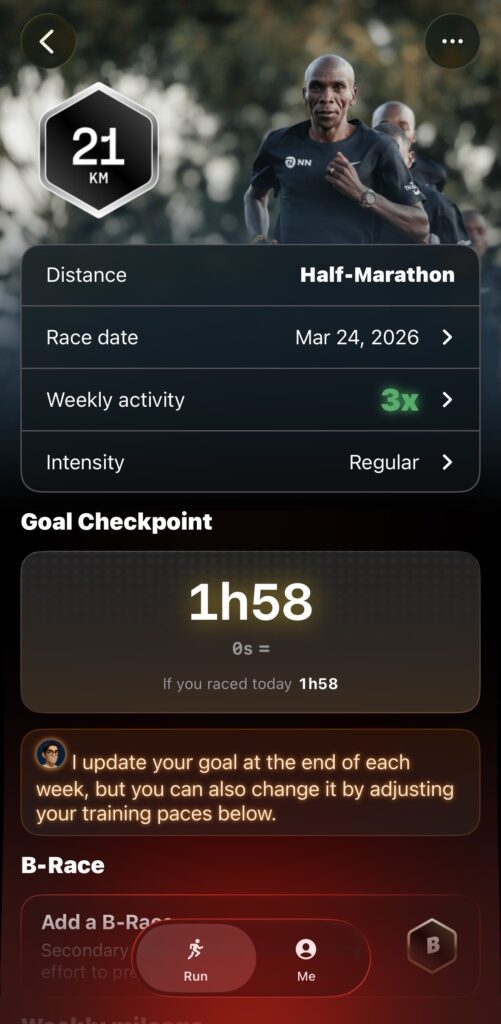
I tested it out. When I typed, “I have pain in my left ankle, what should I do?”, Alix responded: “First, back off running for a day or two and see if the pain settles… Quick rest now saves you from longer downtime later!”. It felt surprisingly sound, like a coach telling me to ice it and take a short break. Another time I asked Dan, “What should I eat for dinner before my Sunday long run?” He answered: “Go for a meal that’s high in easy-to-digest carbs — think pasta, rice, potatoes… Pair it with moderate protein (chicken, fish, or tofu). Skip super fatty foods.” These replies weren’t bland or generic, they echoed real-world coaching. Having 24/7 access to expert advice on injuries and nutrition was a game-changer.
Adaptive Plans & Real-Life Adjustments
Life happens, so Kotcha is built for real runners, not robots. If I had a busy day or missed a session, the plan simply adapted. For example, when I skipped an easy run, the following week’s workouts stayed manageable rather than suddenly spiking. This matches Kotcha’s philosophy: the AI learns your patterns and adjusts continuously. In contrast to rigid plan apps, Kotcha really pays attention.
In practical terms, that meant I never felt chained to an unrealistic plan. If I had only 30 minutes one morning, Kotcha would auto-scale the workout to fit and then re-balance the rest of the week. (This real-time adaptation is being rolled out soon according to the team.) The result: training that felt human. As one tester put it, Kotcha “doesn’t just tell me what to do, it feels like it understands me” (early users reported similar sentiments).
My 7-Day Trial Results
After a week with Kotcha, I can say this: it works as promised. I ran 4 times as planned, enjoyed the variety of sessions, and felt coached every step of the way. The workouts were challenging but reasonable, and adjusting them – whether for missed runs or my subjective fatigue – was seamless. I liked seeing my data charted each day and reading the post-run feedback. By day 7, I felt more engaged in my training, motivated by the app’s AI pep talks and clear structure. (Spoiler: I hit a small personal best in my 5K time that week, although that might be more about motivation than science!)
Technically, Kotcha is a very polished app. The interface is clean, and the chat feature is responsive. Connectivity to my watch was flawless—all of which helps a lot when the goal is to just run. The blending of Kipchoge’s proven training philosophy with smart AI makes Kotcha stand out. Instead of comparing splits or racing friends, I was focused on my own plan, week after week—which is exactly what Kipchoge’s team intended.
Pricing & Free Trial
Kotcha isn’t free (good coaching rarely is). Officially, it costs $14.99 per month or $99.99 per year. That’s in line with other premium coaching apps (and far below hiring a human coach). The company sweetens the deal with trial offers: the first week is free, so you can use the app with no commitment.
Even better, you can get a one-month extension on that free trial by using my code ARUJ at signup. This means you’ll run with Kotcha for 5 weeks before any charge, plenty of time to see if it’s right for you. iPhone users can just click on redeem promo code and enter my code ARUJ to get one month free on Kotcha. On Android, when you click on “Start Free Trial,” you have to set a payment method. Click on that, and you’ll see an option to redeem a code. Enter code ARUJ to get one month free on Kotcha.
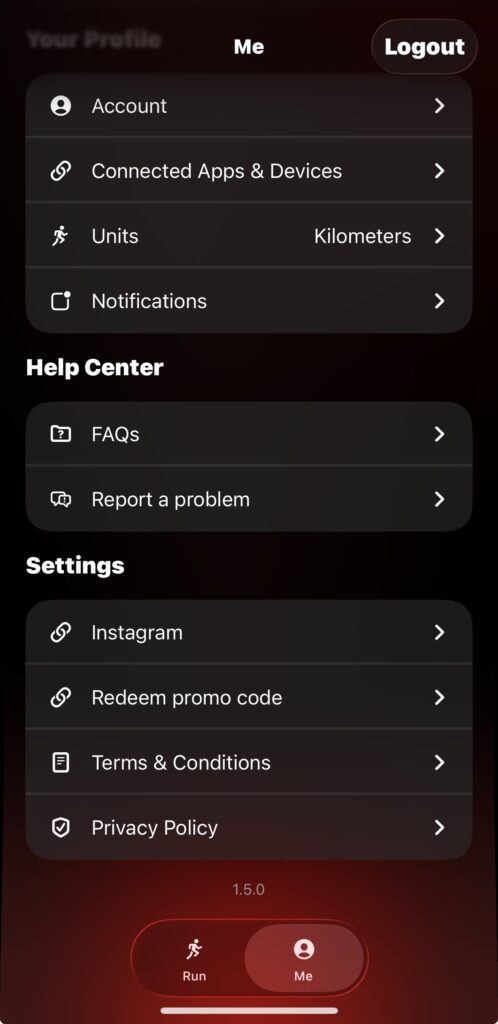
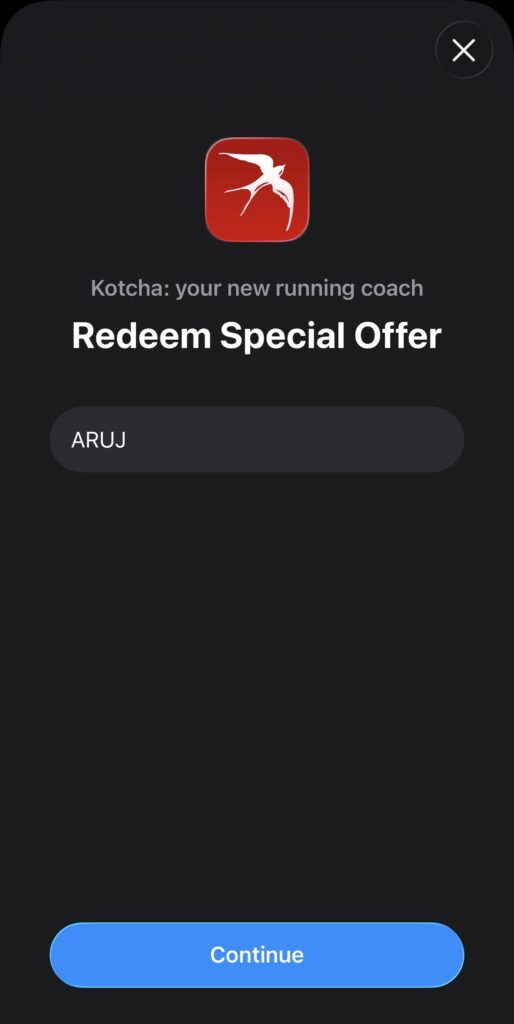
In short, you pay nothing to start: download Kotcha, sign up, and use ARUJ to snag an extra free month on top of the first-week trial. If at any point you’re not happy, you can cancel before the trial ends (Kotcha is upfront about “cancel anytime”).
Conclusion
Eliud Kipchoge’s Kotcha app delivers a truly personalized, adaptive running coach powered by AI. In just 7 days, I saw how its dynamic plans, four AI coaches, and data analytics combine to mimic the attention of a pro training camp. It didn’t feel gimmicky, it felt earnest, precise, and (dare I say) even inspiring.
Whether you’re chasing a PR or just want structure in your runs, Kotcha can guide you. And right now is the perfect time to try: remember, use my code ARUJ to get one month free trial on Kotcha. Lace up, give the NN Running Team’s methods a spin, and see how you like running with a world-class coach in your pocket.